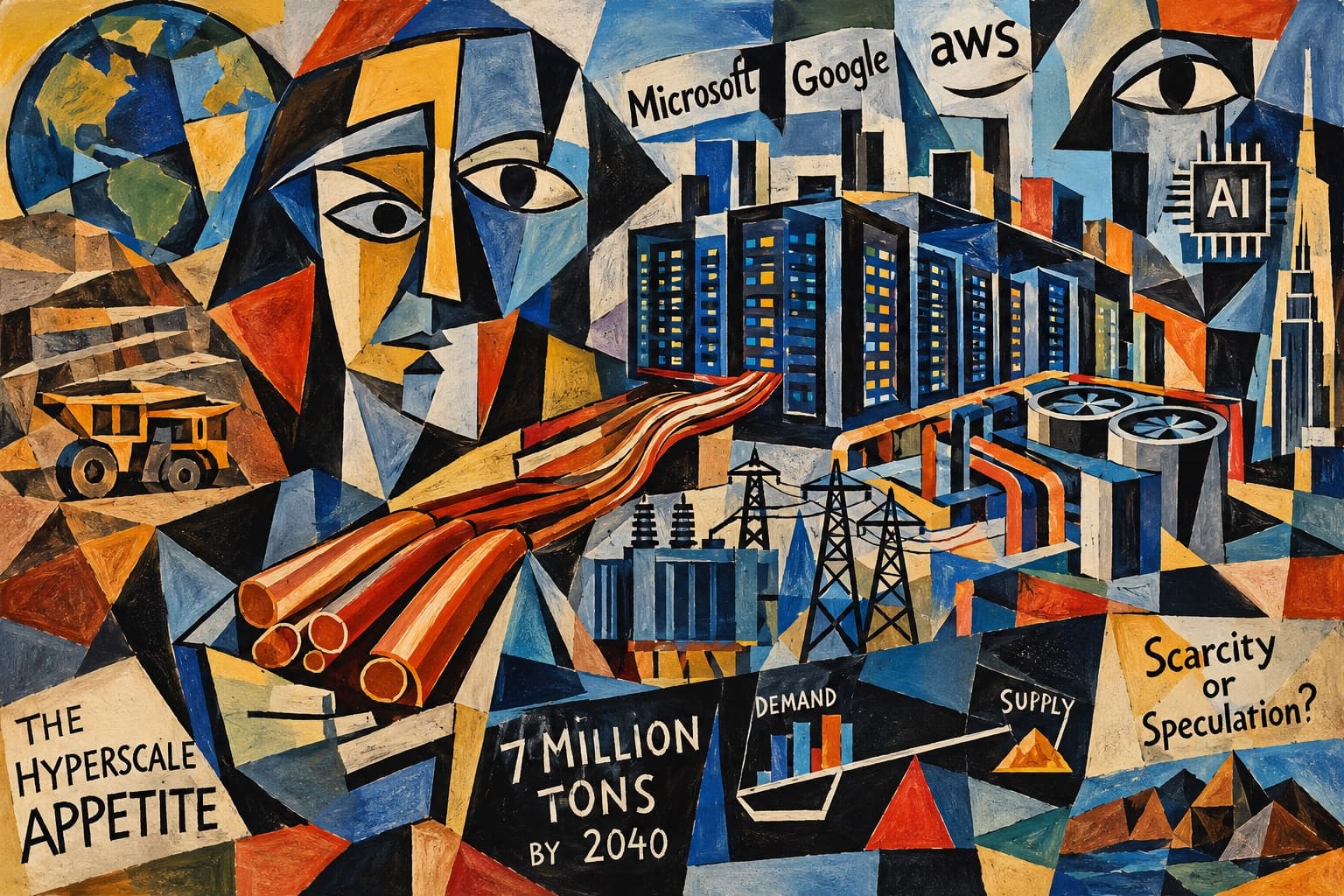
The red metal that electrified the twentieth century has become the world's most contested commodity, hitting an unprecedented peak of $14,600 per metric ton this autumn. Driven by sweeping trade tariffs, aging geological reserves, and an unexpected consumer—hyperscale artificial intelligence infrastructure—copper is caught in an escalating global squeeze. For the AI industry, the timing could hardly be worse: the data centers being built to train and run AI models are among the most copper-hungry structures ever designed.
The crisis ignited in earnest on August 1, 2025, when the United States introduced a 50 percent tariff on copper imports. While analysts at GS902.56▲0.66% initially predicted softened prices due to slowing industrial demand in China, global trading floors reacted with panic. London Metal Exchange (LME) stockpiles plunged as traders redirected metal to U.S. shores to beat subsequent trade measures. The shock accelerated a rally that blew past historical benchmarks, pushing spot prices well beyond $14,000.
The hyperscale appetite
Compounding the supply shortfall is an unmodeled surge in demand: the rapid rollout of generative artificial intelligence.
Hyperscale data facilities built by MSFT517.53▲0.92%, GOOGL343.50▲1.55% and AMZN251.52▲1.32% consume power on par with mid-sized cities. According to estimates by the International Energy Agency (IEA), global data center power consumption is on track to double, underpinned by energy-dense server racks from hardware providers like NVDA233.95▲1.34% that draw tens of kilowatts each.
Every watt delivered requires copper. Inside a flagship data campus, up to 50,000 metric tons of copper—surpassing the volume of structural steel in the Empire State Building—are used across:
- High-voltage utility interconnects and transformers
- Facility-wide busbars and power distribution units
- Grounding grids and internal cable assemblies
- Liquid-cooling heat exchangers and backup generation arrays
Exhaustion at the source
While policy shocks triggered the price surge, the foundation of the crisis lies deep underground. The era of accessible, high-grade ore has effectively drawn to a close.
In Chile, the world's premier copper supplier, output has dropped for three consecutive years:
- Escondida: The world's largest single extraction site suffered a 3 percent production drop in 2025.
- Chuquicamata: Codelco's seven-decade-old flagship open pit faces swelling operational hurdles as extraction shifts deeper underground, requiring escalating capital, power, and water amid dwindling Andean water tables.
- Grasberg (Indonesia): The world's second-largest copper asset, operated by FCX72.04▲3.98%, contends with recurring community protests, environmental scrutiny, and national export mandates forcing domestic refining.
Mining industry analysts note that permitting and constructing a primary copper mine takes anywhere from 10 to 15 years.
The gap between legislative policy and physical geology is measured in decades. The metal refined today originates from deposits discovered when smartphones were just emerging.
| Asset type | Typical copper required |
|---|---|
| Electric vehicle | ~80 kg |
| EV charging station | ~40 kg |
| Offshore wind turbine | Up to 15 metric tons |
| Hyperscale AI campus | Up to 50,000 metric tons |
Scarcity vs. speculation: the 7-million-ton dilemma
The widening imbalance was highlighted in a landmark study by S&P Global, backed by mining operators BHP86.07▲1.68%, FCX72.04▲3.98% and B40.23▲0.32%. The report projects that aggregate demand from electric vehicles and AI computing centers could outpace primary copper extraction by over 7 million metric tons by 2040.
However, market observers urge caution regarding these estimates. Significant discrepancies exist in how baseline demand is tallied:
- Incremental vs. gross allocation: Forecasters frequently lump planned regional grid upgrades and preexisting utility work directly into AI-specific line items, risking double-counting.
- Vested interests: High-profile projection models are frequently underwritten by upstream producers who directly gain from structural scarcity narratives.
Whether the structural shortfall settles at 7 million tons or half that figure, the margin for error has evaporated. Alternative technologies, aggressive scrap recovery, or macroeconomic downturns could soften consumption, yet the physical constraints remain unyielding. As digital architecture and physical infrastructure converge, the trajectory of global computing is now firmly tethered to the limits of the earth.
What it means for the AI build-out
For investors following the AI trade, copper is no longer a background commodity. Every new hyperscale campus from MSFT517.53▲0.92%, GOOGL343.50▲1.55% and AMZN251.52▲1.32% needs transformers, busbars and power distribution before a single NVDA233.95▲1.34% rack is switched on, and each of those runs on copper. A metal that takes 10 to 15 years to bring from discovery to production is now part of the critical path for data centers that are planned in two or three. If the shortfall is even half as large as the industry projects, copper prices and grid hardware lead times become another cost and scheduling constraint on AI infrastructure, alongside chips and power.